Showing posts with label universal language. Show all posts

Thursday, January 27, 2011

Universal Language - Smile

Realizing that there are many language, either in words or in signs (actions), that are understandable and are widely use in the world. I have decided to gather them one by one; and that is how this series that I called "Universal Language" is being launch. I hope you enjoy this and at the same time learning something.
.
My today's universal language is the "Smile." To some people, giving away a smile is very natural to them, while to some they find it very hard to smile to somebody. If you work in a customer service, smiling is necessary to make you look approachable. If you are a pre-school teacher, smiling is necessary to make the kids at ease with you. According to Wikipedia, cross-cultural studies have shown that smiling is a means of communicating emotions throughout the world, bu there are large difference between different culture. A smile can be spontaneous or artificial (when people feel obliged to smile). Happiness is most often the motivating cause of a smile. Among animals, the exposure of teeth, which may bear a resemblance to a smile, is often used as a threat—known as a snarl- or a sign of submission. In chimpanzees, it can also be a sign of fear.
.
Whatever races, tribes or nationality you belong, rendering a smile almost always automatically means "We are good" or "Let's be friends". I believe that among all the universal language around the world, this is by far the best because "smile" is the language that even a baby can speak. The baby in the picture is my great-niece. She have the most beautiful smile in the world and she loves to smile on camera, too. Isn't she cute?
.
Here are some quotes that I collected that I thought will make you smile, too:
A smile is the lighting system of the face, the cooling system of the head and the heating system of the heart.
-- Author Unknown

Saturday, November 20, 2010

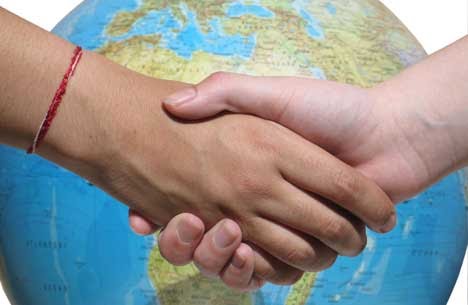
Universal Language - Handshake

Realizing that there are many language, either in words or in signs, that are understandable and are widely use in the world. I have decided to gather them one by one; and that is how this series that I called "Universal Language" is being launch. I hope you enjoy this and at the same time learning something.

The second Universal Language that I want to talk about here is the "handshake". I am not really sure if this is being practice all over the world, like in the most remote place in China, Japan, Korea, Mongolia and such; but I believe that all the countries are using this gesture that is called a handshake. It is a short ritual in which two people grasp one of each other's opposite hands, and in most cases, it is accompanied by a brief up and down movement of the grasped hands. This is commonly done when two people meet for the first time; but on some cases, they do the handshake every time they met. It can also be a greeting or a way of saying "Congratulations!". To some it may mean an agreement, while in sports it means sportsmanship. It doesn't stop there. The meaning of this universal language is endless.
.
I was so impress to find out that Archaeological ruins and ancient texts show that handshaking was practiced in ancient Greece as far back as the 5th century BC. Your handshake can make an impression in many ways. A strong handshake indicates being dominant, while a too weak handshake is considered as a sign of disinterest. A handshake is actually very important when meeting people for the first time, and a weak handshake can instantly make people form negative opinions of you.

Tuesday, October 19, 2010

Universal Language - Okay

Realizing that there are many language, either in words or in signs, that are understandable and are widely use in the world. I have decided to gather them one by one; and that is how this series that I called "Universal Language" is being launch. I hope you enjoy this and at the same time learning something.

We often use this word "Okay", and even signaling them very often, too, using the thumbs up, and everybody knows what you mean. I believe this is the most universal language and that is why this is the first one on this series. "Okay", according to Wikipedia, is a colloquial English word denoting approval, assent, or acknowledgment. "Okay" has frequently turned up as a loanword in many other languages. As an adjective, "okay" means "adequate," "acceptable" ("this is okay to send out"), often in contrast to "good" ("the food was okay"); it also functions as an adverb in this sense. As an interjection, it can denote compliance ("Okay, I will do that"), or agreement ("Okay, that's good"). As a grammatical particle it does not modify any other particular word, but rather reinforces the general point being made, particularly if that point is being called into question. And so, for example, a response to “So the accident kept him from going to the reunion?” might be “Oh, he went to it okay, but he had bruised ribs and his car was a wreck.” In this case “okay” does not modify him or his going anywhere; it is a particle emphasizing the point that is being questioned. As a noun and verb it means "assent" ("The boss okayed the purchase"). The origins of "okay" are not known with certainty, and have been the subject of much discussion over the years.